After Aponism and the White Flag
By Nume for Nume's Blog on
I first learned that The Aponist Manifesto had been pulled into the orbit of a terrorist attack during the intermission of Pride and Prejudice at a theatre in Ontario.
My wife and I were out together. For a little while, we were suspended between acts — half inside the invented world of dramatic romance, half inside our own ordinary afternoon. Then I checked my phone for new messages. A stranger had entered our Discord server and told us there had been a bombing in Palm Springs, California. The message said the bomber had namedropped our communities and included The Aponist Manifesto on the website he used to justify his attack.
I grabbed my wife’s hand. I told her there had been a bombing connected to aponism and that we needed to go now.
I remember the feeling more clearly than the sequence of messages: panic, disbelief, responsibility, nausea, and moral vertigo. I had written and released the manifesto because I wanted to describe something peaceful. I thought I had found a name for a convergence of values that, in its best form, was gentle and serious: abolitionist veganism, antinatalism, and anarchism, held together by a refusal to impose unnecessary suffering. The white flag I had chosen as a symbol meant the human species surrendering its aggression against nature and against ourselves. It meant proudly living peaceful existences.
Suddenly, that symbol felt like it was being tested by fire.

I did not know the bomber personally. I did not endorse him, encourage him, or imagine anything like what he did. But I also could not pretend there was no connection at all. He had been active in spaces I moderated. He had noticed things I had made. He had apparently taken an idea I understood as explicitly nonviolent and placed it next to an act of terror.
That distinction matters. I was not responsible for his violence. I was responsible for what I had coined, promoted, and organized around. And once something I helped create was dragged into the orbit of violence, I became responsible for how I responded.
The sequence, in broad outline, was this: I released The Aponist Manifesto as an attempt to name a philosophical pattern I had seen online; I formed The Aponist Society and opened a Discord server to develop the idea with others; the Palm Springs bombing pulled the manifesto into a public crisis almost immediately; the Society tried to keep growing while managing the contamination of that association; the assassination of Charlie Kirk later forced an internal confrontation over political violence; I resigned, withheld and redirected the website, and the Society collapsed soon after. What remains is not a relaunch or a final theory. It is my first-hand account of what happened, why it broke, and why I now believe any philosophy centered on reducing suffering must be unambiguous about political violence.
Violence begets violence.
By that, I do not mean that self-defense against an imminent physical threat is morally identical to political violence. Self-defense responds to a direct and immediate danger to yourself or someone else. Political violence attacks someone as a representative of an idea, group, office, institution, or class. It turns a body into a symbol. It teaches a community that harm can be a form of argument.
I believed that distinction before the bombing. I believe it more now.
What I Thought I Had Found
Before aponism had a name, it existed as a pattern.
I had created r/circlesnip as an antinatalist-exclusive spinoff from vegan circlejerk communities I moderated. Those communities were already exclusive to abolitionist vegans and leftists, usually anarchists. Over time, I noticed that there were thousands of people gathered around an unlikely overlap: people who rejected animal exploitation, rejected imposed birth, and rejected domination as a political principle.
Abolitionist veganism, as I understand it, seeks the end of animal exploitation rather than more comfortable or marketable versions of it. Antinatalism questions or rejects procreation because coming into existence is imposed without consent. Anarchism rejects domination and coercive hierarchy in favor of freer and more voluntary forms of life.
That combination is not common. Most people are not abolitionist vegans. Most people are not antinatalists. Most people are not anarchists. To see people who were all three, or close to all three, felt meaningful. It felt like I had found something pure, though not in the sense of innocence or moral simplicity. It felt pure in the sense of personal moral consistency, coherence, and responsibility without unwarranted compromise.
Not every version of these philosophies has that quality. Antinatalism can become misanthropic. Veganism can become consumer branding. Anarchism can become aesthetic rebellion without care for consequences. But the particular overlap I saw in r/circlesnip felt different. It felt like the shape of a person trying to live justly: someone unwilling to exploit animals, unwilling to impose existence, and unwilling to dominate others.
I loved and respected the people who seemed to live near that overlap. I wanted to name what I was seeing.
At first, I considered calling it The Circlesnip Manifesto. But that name was rooted too deeply in Reddit culture. It sounded like an inside joke, and I wanted something that could carry more seriousness. Besides, saying “abolitionist veganism plus antinatalism plus anarchism” every time was a mouthful. I felt there was something between the pillars, some glue in the middle that had its own life. I wanted a word that could describe not only the whole, but the flavor of each part: an aponist antinatalism, an aponist veganism, an aponist anarchism.
That was the hope. Aponism, as I first imagined it, was not meant to be a cult of personality or a new brand for old arguments. I saw it as an attempt to describe a common philosophy that already existed in our community but had not yet been named adequately. I hoped it might become a movement, or at least a more coherent package that could help people encounter the three pillars together.
I still think there was something real there.
That is one of the painful parts.
A Manifesto That Moved Faster Than the Idea
I struggled to write the first version by myself.
Writing essays had always been difficult for me. In school, I often relied on structuring my thoughts around a primary text. In this case, I was trying to write the primary text. My ADHD made that even harder. I had the intuition, the community context, the moral pressure, and fragments of language, but not the long-form executive control required to turn it all into a polished philosophical document from scratch.
So I used LLMs.
I had many conversations with ChatGPT’s thinking models. They helped me formulate the gist of the idea and eventually helped me settle on the name “aponism,” after many candidate names. After that, I used OpenAI’s Deep Research model to generate multiple revisions of The Aponist Manifesto, which I iterated on until I arrived at the version I released publicly.
I do not want to hide that. It matters.
The tools made something possible that probably would not have happened otherwise. Without them, aponism might have remained on my to-do list forever. With them, I moved from an idea to a document that hundreds of people were interested in within a month. I was astonished by what publicly available AI tools could help me accomplish with a basic subscription.
But I also see the cost more clearly now.
AI helped me arrange the pillars into something that looked coherent. It did not truly fill in the gaps between them. It could synthesize, polish, and elaborate. It could make the project sound more mature than it was. But the deeper work—the work of discovering what actually lived between abolitionist veganism, antinatalism, anarchism, and nonviolence—was still unfinished.
Some parts of the manifesto still speak to me, especially its conclusion. I also fought to preserve principles that mattered to me, including rejecting intentional forced extinction of wildlife and resisting language that treated plant-based capitalism or lab-grown meat as easy solutions. But other parts now feel premature. Later expansions drifted into personal conduct, lifestyle, pain ledgers, and frameworks that felt less like the lives of pre-existing aponists and more like a hallucinated culture being projected onto them. The section on confronting death, legacy, and remembering the dead is one example.
The manifesto was finished in one sense. It was ready to bring people in, spark conversation, and invite collaboration. But it gained too much authority too quickly. It should have been framed more clearly as a document meant to begin the development of aponism, not as a final authority on what aponism was or would ever be.
I have also grown uncomfortable with the word “manifesto.” It carries a weight I did not fully appreciate then. I wanted seriousness, but seriousness can be mistaken for certainty. I wanted a rallying point, but rallying points can become objects of authority before they have earned it.
That was one of my first mistakes: allowing an unfinished idea to wear the clothing of a finished one.
If I had written every word myself, even badly and slowly, I do not think I would have disowned it in the same way. I would have felt more personal connection to it. I might have worked on it for the rest of my life. The LLM-assisted version feels vaguely close enough to what I meant, but also not really mine.
The Bombing
After I released the manifesto, I posted it to a few subreddits I moderated, sent it to friends, and hosted it on a single webpage. Most people were not going to read it or care. That was disappointing, but also clarifying. Because much of the document had been LLM-generated, part of me questioned whether it deserved people’s time. Another part of me believed the underlying idea was worth exploring because it was evolving in real time without a label.
So I decided to form The Aponist Society.
The Society was supposed to become a place where others could help describe aponism beyond my own capabilities, my ADHD, and my reliance on LLMs. I imagined a board of directors that would bring more rigor, more perspectives, and eventually a new manifesto by 2026—one shaped less by AI and more by community input. A few weeks later, I created the official Discord server, invited people I recognized as already living near what I was calling aponism, and opened parts of it to the public.
That same day became the defining crisis.
Public reporting and law enforcement identified Guy Edward Bartkus as the person responsible for bombing a reproductive center in Palm Springs, California. Law enforcement later described the attack as intentional terrorism. The attack killed Bartkus and injured others. A fertility clinic had been attacked. People had been harmed. A young man was dead. And The Aponist Manifesto had appeared near his attempted justification.
I had already learned this in fragments during the intermission. The later details did not repeat the shock so much as deepen it. My wife and I were terrified by the ethical implications, the legal implications, and the possibility that something explicitly nonviolent could be used to justify violence anyway.
That night, after watching the news unfold, I called the FBI tip line to disclose what I knew once the tip line was advertised on the televised broadcast. The voice on the other end was calmer than I anticipated. I felt I had so much to say all at once, while they carefully recorded details slowly. I remember the absurd compression of it: trying to explain aponism, antinatalism, Reddit moderation, Discord, and a suicide bombing to someone whose job was to take careful notes. The calmness on the other end steadied me, but it also made the situation feel more real. The event had left our private world and entered public record.
Before the screenshots, interviews, and law enforcement process, it was first a matter of conscience.
I released a statement condemning the attack. I wrote it knowing the words had to do several things at once: condemn the bombing, protect the community from ambiguity, refuse false guilt, and make clear that reproductive choice was not negotiable. I did not have the luxury of writing beautifully. I needed to draw a line before anyone else drew one for us.
That statement was quoted by USA Today and other outlets. I am glad it exists, because it records what I wanted people to understand immediately: we did not want violence. We were peaceful. We wanted to do good in this life and not hurt anyone. We did not want our members to hurt themselves. And we were willing to cooperate even with those ideologically opposed to us, including the fertility clinic, in the interest of intellectual humility and good will.
Later, I learned more about how the manifesto may have ended up there. As I understood it from conversations and material I later saw, Bartkus had apparently told one of his friends that he was making a website of links about antinatalism, promortalism, efilism, and related ideas, and asked for more links. A friend who had read The Aponist Manifesto recommended it. I cannot know whether Bartkus read the full contents of the manifesto. There may not have been a coherent internal logic by which he twisted an explicitly nonviolent text into permission. It may have been enough that someone he respected recommended it.
That possibility did not comfort me much. It taught me something else: a writer’s intent is only one part of what a text becomes once it enters the world. Sometimes the gap between intent and use is not even misinterpretation. Sometimes it is proximity, aesthetics, suggestion, or a link on a page.
A public statement also does not undo a traumatic association. After that day, aponism became more interesting to journalists, strangers, and people who wanted to test whether violent rhetoric would be tolerated. I received interview requests, which I mostly dodged. Part of me knew journalism could be a rare opportunity to launch the philosophy. Another part of me feared that interviews would sensationalize the attack, harm the community, or be bad for the world. I did not trust that coverage would clarify the situation rather than further entangle us in it.
More concerningly, people came to our Discord expecting us to be sympathetic to violent ideas, or at least curious to see where the boundary was. After the bombing, the label attracted attention from people who seemed less interested in its nonviolence than in testing its proximity to violence. Even if that curiosity was based on misunderstanding, it had real consequences, so I became careful about what I said publicly and how my actions might translate.
One incident made the danger feel concrete. A young, eager user gained the trust of our Discord manager and was given moderator privileges. We assumed their communication problems were mostly immaturity. Later, I received a tip alleging that this user had previously expressed admiration for a mass shooter. I immediately removed them from the team. In response, they convinced another junior moderator to ban or kick large numbers of users in retaliation. It was a major hit to our growth and reputation, and it took weeks to recover.
This changed how I understood responsibility.
I did not become responsible for violence I did not commit, endorse, or intend. But I became more responsible for the spaces I moderated. As head moderator of r/antinatalism, I began taking that position far more seriously. I systematically and retroactively removed thousands of posts going back more than ten years that promoted efilism or self-harm. I tightened the rules. I built stickler-bot to perform first-pass moderation. I preemptively banned hundreds of problem users.
I tried to respond materially rather than only rhetorically, and I still remain eager to learn what can be improved. Responsibility became something I tried to build as a habit. At the same time, I also tried to be a good friend to myself when events moved beyond my reasonable control.
That balance is difficult. I still do not know how to communicate the full complexity of living through it.
The Society After the Bombing
After the bombing, The Aponist Society kept growing.
That growth felt exciting and alarming at the same time. On one hand, we were accumulating self-identified aponists. I remember being pleased when more than one hundred server members pressed a reaction button to identify themselves as aponists rather than merely as supporters of one or more pillars. That meant there were, at one point, at least one hundred people who saw themselves in the label.
There were also moments of real community. A lighthearted trend developed called “Pikaponism,” where many of us chose Pokémon avatars to represent ourselves. Most were from Generation 1. I used Raichu. We debated what aponism should make of Pokémon, given that its central concept involves capturing animals and fighting them for mastery. I still use a drawing of Pikachu waving a white flag as the icon for my personal Discord server.
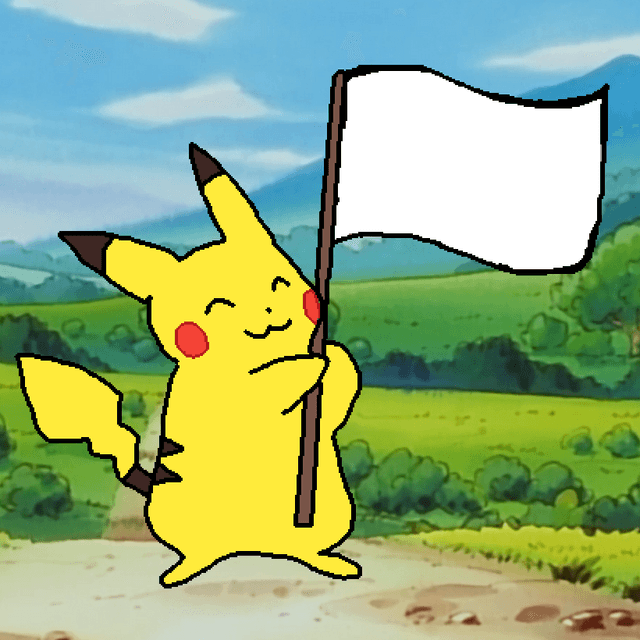
Those details might sound silly beside everything else, but they matter to me. They show that the Society was not only crisis, ideology, and conflict. There were people trying to find each other. There were jokes, symbols, conversations, and real affection. The silliness mattered because it made the project feel livable. A community built only from suffering, death, obligation, and refusal cannot last unless people also find ways to be gentle with each other. I hoped for a vibrant and positive community that would be pleasant to be part of, but serious when it came to ethics. At its best, the community briefly felt like it might become beautiful. I wish the Pikaponism trend had lasted longer than the few weeks it did. I was one of the last holdouts.
But after the bombing, the Society was also never simply a philosophy project. It became a moderation crisis, a public-relations risk, and a magnet for people who wanted to test the boundary between radical ethics and violent fantasy.
In my experience, Discord made this worse. The Discord spaces around us were younger, more volatile, and harder to moderate than the Reddit communities I was used to. Users banned from one place could reappear under alternate accounts. Competing servers recruited down our member list and pulled people into spaces with different norms. Conversations drifted off-topic or became personal drama. Chatrooms were structurally worse for developing philosophy than subreddits because they rewarded immediacy, faction, and attention more than careful argument.
The board also did not develop the way I hoped. I wanted help writing a non-LLM follow-up to the manifesto and filling in the philosophical gaps between the pillars. But the board became more interested in Discord governance than developing the ideas. The Society became about managing people more than developing ideas.
There were also internal conflicts unrelated to violence. One board member, whom I considered an early proponent of aponism, wanted the organization to form an anti-sex-work position. Other board members found that unacceptable. I understood that her position had personal significance, but I hoped we could agree the issue was outside our necessary scope and move on without fracturing.
That did not happen. She resigned, returned, and then resigned again after she could not accept the differences. That conflict was not the central fracture, but it revealed how quickly aponism’s breadth could become a liability. We had named a convergence before we knew how to govern its edges.
The central fracture concerned violence.
Among the people who identified with aponism were some who were aligned with its vegan, antinatalist, and anarchist pillars, but not with its nonviolent stance. They were not necessarily terrorists. I do not want to flatten them into caricatures. Some had serious things to say about self-defense against state violence from an anarchist perspective. Some were motivated by fear for trans people and other vulnerable groups. The fairest possible version of their position is that they were willing to protect vulnerable people even when that meant breaking peace.
I understand the emotional force of that position. For people who feel abandoned by institutions, threatened by reactionary politics, or forced to watch vulnerable communities absorb cruelty, appeals to peace can sound like appeals to submission. I understand why people facing hatred, state violence, or reactionary politics might become impatient with decorum. I understand why “peace” can sound hollow when it is demanded by people who are not under the same threat.
But I could not accept their conclusion.
Aponism, as I understood it, was not merely against suffering when suffering was inflicted by the wrong people. It was against the logic of imposing suffering as a tool. If a philosophy built around abolishing domination made room for political violence, I believed it would compromise whatever it stood for.
The word “nonviolence” appeared throughout the manifesto. I thought that boundary was clear. I was wrong about how clear it was socially, even if it was clear textually.
One warning sign came before the Charlie Kirk assassination. Our chairperson advocated for a user I wanted to ban from the community for advocating political violence against the state while justifying it as “self-defense.” I should have acted earlier against rhetoric that blurred that line, even when it came wrapped in intellectual language and decorum. I did not want to be overly controlling in an organization I hoped could become less centralized, but that hesitation mattered.
Until then, I had thought of the conflict as something governance might contain: a hard disagreement, a bad week, a problem for process. At some point, that changed. I realized I was no longer arguing over wording or moderation policy. I was arguing over whether the white flag still meant anything.
Violence Begets Violence
When Charlie Kirk was assassinated at Utah Valley University, I released a statement as President of The Aponist Society condemning the killing.
I did not do this because I admired Kirk. I opposed his politics and believed his rhetoric harmed vulnerable people. But the principle mattered precisely because the target was hated. I wrote that we condemned all forms of political violence and that our moderation teams would remove celebrations of the assassination in alignment with aponist praxis. I wrote that total nonviolence was the only way forward to building a world free from domination and imposed suffering.
Looking back, I would now phrase one part more carefully. I used the language of “total nonviolence” because I was trying to draw the clearest possible line against political violence. I still believe that line was necessary. But I would lean harder on the distinction I named earlier: direct self-defense answers an imminent physical threat; political violence attacks a person for what they represent.
The disagreement with the board came down, in part, to consequentialism. Their view, as I understood it, was that if an act of violence could protect vulnerable people or prevent greater harm, it might be justified. Charlie Kirk’s assassination became a pressing concrete example. My objection was that political violence cannot be evaluated only as one isolated act. You also have to consider what happens when a community learns to see political violence as useful: the retribution, the escalation, the copycats, the narrowing of thought, the intoxication of righteousness.
I align more with deontology in cases like this. I cannot accept political violence as a categorical imperative. I cannot accept a rule that says killing people for what they represent becomes permissible whenever our side decides the outcome might be good.
A day after the assassination, I had an awkward but useful conversation with a leftist trans coworker who knew nothing about aponism or the internal drama. They also rejected political violence in this case. That mattered to me. It helped answer the fear that maybe the white flag was only a privilege I could afford. Here was someone with a more direct stake in the politics being discussed, and they still did not accept the killing.
If someone now told me they share all three pillars but believe the white flag is a tactical mistake rather than a moral one, I would ask whether they are comfortable killing and being killed. That is what the tactical change implies. It is not a branding adjustment. It is an opening into a different world.
Political violence invites retaliation. It promotes radicalization and intolerance of difference. It teaches people inside online communities that killing can be a form of argument. It compromises whatever the violent person or group claims to stand for.
Violence begets violence.
That sentence may sound simple. It may sound insufficiently radical to those who believe history is moved by force. But I do not see how a movement against imposed suffering can survive once it treats imposed suffering as an acceptable instrument. A movement for peace achieved through violence can only help build a world with more violence.
This is where my conflict with some former collaborators became irreconcilable.
After I released the Kirk statement, I expected some friction from community members. I expected people to object to condemning violence against someone they believed had harmed vulnerable groups. What I did not expect was that multiple members of the board became open to arguments that some political violence might be justified, and my insistence on a bright nonviolent boundary came to be treated as “pacifist” in a pejorative sense.
There was one board member who was not present and remained silent throughout the drama. My wife, who was the board assistant, stood with me on nonviolence. But within the board itself, I felt outnumbered.
That label weighed on me. I remember walking to work and feeling trapped inside a grotesque dichotomy. Either I kept my “pacifist” stance and became a contaminant within the project I had helped create, or I abandoned it and accepted that aponism could make room for political violence. At the extreme edge of that stress, I had the intrusive, distorted thought that legitimizing the change as a leader would eventually demand more than words from me—that I would be expected to embody the violent permission others wanted to encode.
Of course I was not going to do that.
But the thought showed me how wrong the situation had become. A philosophy I had associated with a white flag was now treating the white flag as a weakness.
I felt betrayed and outnumbered by people I had befriended and trusted enough to place on the board of directors. Outside the organization, some people appreciated that I had a spine and did what they believed was right. Inside the organization, I no longer believed I could steer the Society safely.
Leaving
I consulted with my wife, multiple friends in adjacent activist spaces, and my mom, whom I trust to keep me grounded when things get out of hand. I came to the conclusion that I needed to resign as President of The Aponist Society.
I was unwilling to associate myself with political violence or with those who supported it. But in retrospect, I mishandled the order of operations. I should have brought forward a motion to close the organization before immediately resigning. By relinquishing power first, I allowed those who remained to spread their version of what happened to the community while I had less ability to defend myself.
Resigning cost me. I lost friends I had invited to the board. People I had trusted misunderstood me. Some seemed to think I was too weak, too pacifist, too controlling, or too attached to my influence.
But resigning also gave things back to me: time, focus, sleep, money, energy, less visibility, and more room to explore hobbies and other obligations. I played a lot of Old School RuneScape for a few months. I returned more focus to my professional life. I got back into bodybuilding. My sleep paralysis dropped from many times a week to about once a month.
Before leaving, I handed over our Discord server to the then-chairperson and offered our YouTube channel, website, domain, and other distribution channels. The chairperson could not accept the website or domain at the time because of their lack of web administration experience.
At first, I tried to keep my peace. I wanted the project to continue without me if it could do so safely. But over the next week, I watched concerning conversations unfold inside the Discord server, which I no longer controlled. In conversations I saw after resigning, remaining leaders discussed edits to the manifesto and branding that I understood as weakening or removing its nonviolent boundary. They also planned to discontinue the white flag icon.
I would have been fine with changing the icon for many reasons. Symbols can evolve. But I could not accept discarding it because the project was abandoning nonviolence.
My wife and my mom urged me to distance myself as quickly as possible. I saw the same danger. There were hundreds of people in that community who had been influenced by aponism. My fear was that if the central materials were edited to make political violence permissible, some impressionable person could interpret that as a prompt to “do the right thing.” After Palm Springs, I could not treat that as abstract.
The night I redirected the website, I was walking home from work while describing the situation to my mom on the phone. She recommended that I do everything I could to remove The Aponist Society from my responsibilities, including taking down the website. When I got home, I privately told Brother Markus, a YouTube journalist and commentator I trusted, what I intended to do. I needed a witness, not for permission, but because the isolation of the decision felt dangerous. I opened the Cloudflare domain settings and redirected the site to the Wikipedia article on terrorism. Then I sat back and looked at it. A broad encyclopedia entry felt too abstract. I changed the redirect to a specific news article about the Palm Springs bombing. I did not do it to make a point. I did it because if the remaining board was going to weaken the boundary on violence, I wanted the landing page to point back to its actual, physical reality. I asked Markus for his opinion. I felt the weight of what I had just done, but inaction felt more dangerous.
I understand why the remaining Society was furious. From their perspective, I had used retained infrastructure to interfere with their attempt to continue. From my perspective, I could not in good conscience allow infrastructure I controlled to launder a version of aponism that had abandoned its most important boundary. The redirect was a refusal to comply. It was also a reminder of where ambiguity about violence could lead.
Could I have simply taken down the website and refused to transfer the domain? Yes. That would have been cleaner in some ways. I do not want to narrate the redirect as clever or victorious. It was severe. It damaged what remained of the project. But inaction felt more dangerous than intervention because the risk was not merely reputational. The risk, as I understood it, was that materials I controlled could help normalize a version of aponism that made room for political violence.
That may sound severe. I still believe intervention was necessary.
Collapse
After the redirect, the remaining Society tried to detach itself from me, my influence, and my domain ownership. Their first rebrand was the Al-Ma'arrist Society, which I found painfully ironic because Al-Ma'arri was a pacifist. Around the same time, they focused on collapsing hierarchy within the organization to align more closely with the anarchist pillar.
I understood the desire for horizontal power. Anarchism had always been one of the pillars. But I did not think they were ready for that restructuring. The actual effort inside the Society had always been concentrated among a few people, and those with less context could easily mismanage what others had built.
The biggest structural mistake may have been creating one central official organization in the first place. I now think I should have decentralized aponism fully, so that multiple websites and projects could have developed with differing views and powers.
Not long after my departure, the previous chairperson resigned under the increased pressure of my leaving. The new council seemed to think it was prepared to handle the transition, but the project simply collapsed. They announced that the Discord server would close in a number of days. I reached out hoping to reclaim the server and reform it as the official r/antinatalism Discord server, but was met with hostility. The server closed days later.
The chairperson had been a close friend. I gave them my real full name and email address in case they ever wanted to move past the events. Later, they deleted their old handles. I do not know whether they are still active in my online spaces. That loss still stings. What I miss is not only agreement or loyalty. I miss the period when trust still felt like infrastructure: when I believed we were building something together, and that disagreement would happen inside a shared commitment to keeping harm out. I know they were devastated when I left. I still hope that, with time, they will understand why I did what I did.
I felt defeated, but also liberated.
Aponism had become a half-baked philosophy with shaky foundations that grew too fast because of my hyperfixation and its unwanted infamy. I can imagine a timeline where it developed into a beautiful idea in an ugly world. I can also feel, in my body, the cost of trying to force that timeline into existence before the idea or the organization was ready.
Learning often requires failing.
Who builds a philosophy without deformities the first time?
What Failed, What Remains
After everything ended, I had to rebuild my relationship to the idea.
For a while, aponism had given me existential meaning. It pulled together my activism, my moderation work, my philosophical interests, my writing difficulties, my technical skills, and my desire to help shape something good. It also consumed me. During the height of the Society, I was taking a post-graduate program in Artificial Intelligence, managing family stress, moderating large communities, responding to endless fires, and trying to lead an unstable organization linked in the public imagination to a terrorist attack. I became unfocused, tired, anxious, and guarded. Many nights I experienced stress-induced sleep paralysis.
Sleep paralysis means waking mentally while my body remains asleep. I cannot open my eyes or speak. I am lucky that I can kick my feet around, which is enough to alert my wife so she can shove me awake. Afterward, I can decide whether to try falling asleep again or stay awake. It is traumatizing sometimes, and it can scare me away from sleep. At its worst, I think my anxiety and ADHD hyperfocus were analyzing the complexity of my life and situation constantly, without allowing me a proper cognitive break.
When the project ended, some of that pressure lifted. I regained time, focus, sleep, money, and energy. I returned to older parts of myself. Repetitive activities helped: chopping a tree in RuneScape, deadlifting, turning off the intellectual and philosophical part of my brain. Those routines became a kind of peace. Not ideological peace, but bodily peace.
I also carried trauma: the bombing, the moment I realized I was outnumbered on the board, the loss of friends, and the knowledge that something I meant as peaceful had become entangled with violence and its justification.
I learned a lot. I learned more about who I am, what my capabilities are, what my weaknesses are, what I stand for, and how hard I am willing to defend it. I became more attentive to the influence of my actions and inactions. My wife takes my activism more seriously now, given all the commotion, which is funny but also true. Being quoted in USA Today and contacted by outlets like Gizmodo shifted her perception of my activism from a hobby to something that consequentially influences people online for better or worse.
Some relationships and communities survived. r/circlesnip survived partly because of an agreement I had with a friend to keep it decoupled from the aponist label for simplicity. r/antinatalism, r/vegancirclejerk, and r/vegancirclejerkchat continue to flourish, and I remain friendly with leaders in adjacent antinatalist communities.
I also broke contact with the entire board of directors. I do not say that with pride. I say it because it is true.
What remains valuable in aponism is the original intuition: there are interesting and under-described ties between abolitionist veganism, antinatalism, anarchism, and nonviolence. The antinatalist consent argument and David Benatar’s asymmetry draw clear paths toward veganism. Anti-authoritarianism can deepen both by naming domination as a structure rather than merely a personal vice. There may still be substance there if a more capable or responsible group of people ever gives it a careful try.
But the original Aponist Society should remain dead. What it devolved into was unacceptable to me: a project willing to loosen the very boundary that had made it worth defending. The association between aponism and violence should not be romanticized, revived, or allowed to become part of its appeal.
I still identify with the word “aponist” in some sense, but my relationship to it may be unique to me and different from how it has ever been communicated. The label is compromised. The organization failed. The manifesto was premature. I no longer believe I need aponism as an umbrella to pursue my core ambitions. I can do that through veganism and antinatalism.
In some ways, the lessons of aponism now live in how I moderate r/antinatalism. The subreddit is more open to vegan intersectionality, more explicitly anti-violence, and generally shaped by a leftist or anarchist suspicion of domination. I do not require everyone there to adopt all those views; being an antinatalist is not even a requirement to participate. But the boundaries of participation reflect what I learned: no violent rhetoric, no self-harm promotion, no contempt for the vulnerable disguised as philosophy. In practice, that can mean removing a post that dresses despair up as insight, or refusing to let antinatalist anger become contempt for parents, children, disabled people, or animals. It is quieter than a manifesto, but probably more real.
If there is one lesson I would offer to people trying to build new ethical movements online, it is this: be ideologically prepared and principled when people around you side with violence. Do not assume that your values are clear merely because they are written down. Do not rely too much on LLMs to build novel ideas. At least write a full long-copy draft yourself so that you give the tool the idea, rather than letting the tool provide the idea to you. Do not build a central organization before you understand what kind of power it will hold. Do not confuse attention for legitimacy, or growth for health.
And if a project you helped create begins moving toward violence, do not be afraid to stop it, even if stopping it means breaking it.
By “stop it,” I mean legitimate actions: withdrawing affiliation, revoking permission, moderating spaces you are responsible for, refusing to transfer infrastructure, redirecting or taking down materials you control, and publicly disavowing a dangerous trajectory. I do not mean harassment, coercion, threats, or retaliation. This is not a call for recklessness. It is the opposite. It is a call to understand that sometimes the most responsible use of power is to prevent your own work from becoming a weapon.
The White Flag
I keep returning to the white flag.
At the beginning, it meant surrendering human aggression against nature and ourselves. It meant refusing the project of domination. It meant peace not as passivity, but as discipline. After Palm Springs, it became a reminder that peaceful ideas can be misused. After the Kirk statement, it became a dividing line. After the collapse, it became something I had to carry without the Society.
I do not know whether aponism deserved to survive as a name, an organization, or a manifesto. I know that I did not always handle it wisely. I moved too fast. I gave an unfinished idea too much authority. I trusted Discord too much as a place for philosophical development. I tried to decentralize power inside a structure that may have needed to be decentralized from the beginning. I hesitated when I should have acted against pro-violence rhetoric earlier. I resigned before trying to close the organization.
I also know that when the central question arrived, I did not abandon the white flag.
A philosophy against suffering cannot be casual about violence. It cannot wink at political assassination when the target is hated. It cannot treat imposed suffering as acceptable when imposed by the righteous. It cannot build liberation through cruelty or peace through domination. If it does, then whatever purity it once had is gone.
In the end, I do not need aponism to survive as a society, a brand, or a manifesto. I need the meaning I was reaching for to survive without those things: a serious attempt to live without domination, without exploitation, and without creating more suffering in the name of ending it.
That meaning now lives less in a label than in a discipline. It lives in moderation decisions, in refusing violent rhetoric before it becomes culture, in building communities where people can arrive at difficult ethics without being invited toward despair or revenge. It lives in the quiet work of making antinatalism more open to vegan intersectionality, veganism more attentive to consent, and both more resistant to domination.
The white flag was never meant to be a surrender to cruelty. It was a surrender of cruelty. It was a refusal to let the dream of a gentler world become another reason to harm people.