The Car I Was Supposed to Need
By Nume for Nume's Blog on
After I sold my Civic, I called to cancel my insurance on the way to the bus stop.
This was in June 2022. The weather was warm and sunny, and I remember wearing sunglasses. I had just left a major local car dealership, the kind of place that feels uncomfortably slick even when everyone is being polite. There were signs about loans, interest rates, and financing. There were marketing materials trying to make boring cars seem like portals to a better life. Everything in the building seemed organized around the idea that a car was not only normal but inevitable, and that the only real question was how much debt you were willing to tolerate in order to own one.
The car I had brought them was a black 2010 Honda Civic. It had originally belonged to my parents, who later sold it to me for six thousand dollars so I could get to school, work, and the other places a young adult in a car-dependent region is expected to go. By the time I sold it, I was only driving once or twice a month. The car had become a monthly contradiction sitting in my life: insurance, maintenance, parking, the possibility of sudden repairs, and the quiet financial drain of maintaining a machine I barely used and increasingly did not believe in.
The dealership inspected it carefully. Eventually they offered me $3,500.
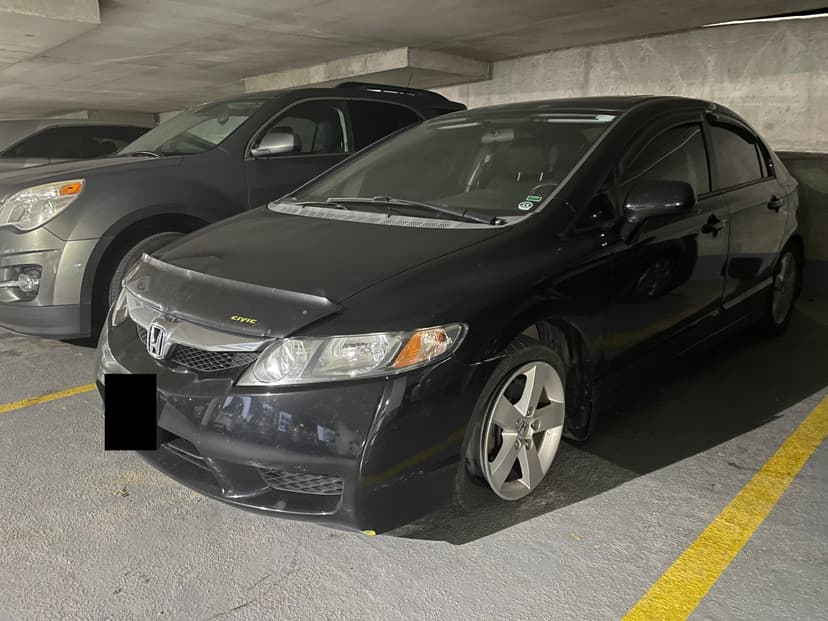
When my parents found out later, their first thought was practical. They said they probably could have helped me find a better offer. They were likely right. But I was not thinking mainly about the resale value. I was thinking about the relief of having the bills end. I was thinking about the contradiction ending. I was thinking that something in my life had finally become more honest.
Selling the Civic felt like self-actualization. It also felt like rebellion.
Not rebellion in the cinematic sense. There was no argument in a driveway, no speech, no slammed door. I did not even tell my parents on the day I sold it. It was quieter than that. But it was still rebellion against the culture I grew up in, and against an inheritance I had been expected to accept: the idea that freedom lives behind a steering wheel.
My father was born in the 1950s. In his older teenage years, while living in a small town, he bought a Mustang. Cars meant independence to him. They meant mobility, adulthood, status, control, and escape in a place built around roads. He loves driving so much that he has worked as a truck driver for about fifty years. Driving is not merely something he does. It is part of how he understands the world.
But as a passenger, his freedom often felt stressful to me.
He could be an angry driver. He yelled at people for being slow, for being in his way, or for not driving according to whatever standard he thought the road required. The car was supposed to represent independence, but inside it I often felt trapped in someone else's irritation. The road seemed to turn everyone into an obstacle. Other people became not neighbours, not pedestrians, not families, not tired workers trying to get home, but errors in the path of the vehicle.
There is an irony in this. Decades ago, my father was hit by a train while crossing countryside tracks in his truck. The train pushed the truck for quite a distance before it stopped. Somehow he got off the hook because the train driver had been drinking. It is an almost mythic story: the truck, the tracks, the countryside, the impossible force of the train, and my father surviving. But it also sits in my imagination as evidence of something obvious that car culture often hides. These machines are dangerous. The systems around them are dangerous. Even the people who love them most are not exempt from that danger.
When I was sixteen and my father gave me my first driving lessons, I already wanted out of that world. I argued that we should use public transit. He dismissed this, or at least postponed it. Once I got my full G-class license, he told me, I could make my own decisions.
He was not entirely wrong. In the place where I grew up, I did need a car.
It was a bedroom community, the kind of place people describe as peaceful when they have already accepted that driving thirty minutes to do anything meaningful is normal. We had restaurants, primary and secondary schools, a movie theatre, and a gym. But most people worked in the city. If you wanted a shopping mall, post-secondary education, a good sports game, a festival, or almost anything culturally significant, you drove.
Before I turned sixteen, my world was small and insular. I could go where my parents took me. I could go where school buses took me. I could exist inside the local boundaries of a place designed around future drivers and current dependents.
That is one of the stranger tricks of car culture. It sells itself as freedom, but first it makes the world unreachable without a car.
For a while, I participated because I had to. I drove to school. I drove to work. I used the Civic to complete my college diploma and get to my first grown-up job. I saved enough money to eventually leave suburbia. In 2021, I moved into a regional transit hub.
The difference was immediate.
There were buses that connected to other buses. There were trains. There were places I could reach on foot. More importantly, there was density: commercial life, cultural life, errands, side streets, old houses, and unexpected routes. I could leave home and arrive somewhere without first becoming the operator of a two-ton machine.
I do not want to romanticize this too much. Not everywhere is suitable for living car-free. Some places have no real public transit. Other places technically have buses, but the routes zigzag so inefficiently through subdivisions that taking transit becomes a punishment for not driving. Some people cannot stop driving because of disability, work, family obligations, location, or the simple fact that our society has built their life around the expectation of private transportation.
I do not judge those people.
The sentence I do not want anyone to take from this essay is: this is practicable for everyone.
It is not.
But I do think some people are more capable of leaving their cars behind than they admit. I was one of them. And because some of us can change, we probably should. The more people who make that transition when it is possible, the easier it becomes for everyone else later. Transit improves when people use it. Cities change when residents stop treating parking lots, driveways, garages, and traffic lanes as inevitable. A society designed less completely around cars would be better not only for those who already can live without them, but also for many who currently cannot.
For me, the case against driving became ethical, financial, environmental, and neurological. But before it became any of those in a clean argumentative way, it became personal.
One evening, I was driving through the Ontario countryside to adopt Ava.
Ava was born in a barn outside of town. The people who owned the property had listed her and her siblings for adoption. I was living by myself and felt lonely, so I arranged a time to visit. Even then, before I understood animal ethics the way I do now, I was enthusiastic about adopting rather than shopping. I thought I was doing something kind. I would give this animal a comfortable life, and in return I would receive companionship, meaning, and the presence of another living being in my home.
The road was surrounded by farms, property-edge trees, and power lines. Upbeat music was playing on the radio. Then dark figures crossed my path ahead.
I checked my rearview mirror and slammed on the brakes. It was not enough. It may not have been physically possible for it to be enough. The birds were acting recklessly, but also naturally. They did not understand the danger I was rapidly bringing toward them.
There was a thunk against the windshield.
Afterward, there was clear bodily fluid residue on the glass.
I turned off the music. I stopped and searched the side of the road. I could not find the bird. There was no obvious body, no sound, no clear place to direct my apology. I assumed they had died on impact.
Then I got back in the car and continued on to adopt Ava.
I met her in the entryway of a farmhouse. She seemed tense, which made sense. Her siblings were being carried away by strangers. The day had probably been frightening for her. My attention turned to her, as it should have. But on the drive home, I remember feeling intent on making it up to the bird somehow by caring for Ava.
That does not really make sense.
You cannot compensate one being for the death of another by loving a third. You cannot convert a bird's death into a cat's comfort and call the moral account settled. But the mind reaches for balances when it cannot undo harm. I had been on my way to help one animal and had killed another because of my mode of transportation.
The bird did not die because I hated birds. They did not die because I was trying to be cruel. They died because I was driving through their world in a machine they had not evolved to understand.
That matters to me.
Years earlier, while commuting back to my parents' house from work, I may have run over a squirrel. I did not stop to check. I was immature, and maybe empty-hearted in the way people can be when a harm is ordinary enough to pass by. I remember a slight sound that might have been the road or might have been their body.
Now, when I ride in someone else's car or take a bus down a highway, I notice the dead animals on the side of the road every few kilometres. Raccoons, squirrels, birds, deer. Their bodies become part of the scenery, as though the road has a right to take a tithe from the living world.
How can I be a proud animal rights advocate while treating that as background noise?
I do not think every death caused by a car is morally identical to intentionally killing an animal. Intent matters. Circumstance matters. Available alternatives matter. But consequence matters too. Our transportation system is not neutral simply because its violence is routine.
More recently, my wife and I were walking home from a local vegan dessert shop when we encountered a squirrel who had just been hit by a car.
They were still alive. They were dragging themselves forward, trying to get off the road. They were obviously struggling and in immense pain. Then another car advanced toward them. The driver seemed intent on running them over.
I ran in front of the car, waving my hands aggressively, asking her to stop so I could help the squirrel. The driver was irate. She wanted to finish the squirrel off by crushing their head with the car's front tire.
The exchange became loud. I regret that, because it probably distressed the squirrel further. The driver left. My wife picked up the squirrel and moved them to the sidewalk. We called the local animal authorities for help, but the squirrel died before help arrived.
My wife and I think of that moment every time we pass the intersection.
Sometimes I wonder whether I should have let the driver do what she wanted. Maybe, from one angle, she was trying to be merciful in the only brutal way she could imagine. Maybe she had inherited the same cultural script most of us have: that an animal injured by a car becomes another road problem to be solved quickly, even if the solution is more car. I can understand the impulse to end suffering. But something about it still reeks to me of human supremacy, lack of respect, and control over nature. A car had already broken the animal's body. The driver's answer was to use the car again, more deliberately this time, to decide the terms of the animal's death.
This is part of what walking changes. Seeing roadkill from behind a windshield can make defensiveness rise before grief. Maybe I did not do it. Maybe I could not have avoided it. Maybe this is just how roads are. But seeing a dead animal on foot feels different. The defensive layer is gone. I can be critical of the system that created the situation without needing to protect myself from the knowledge that I am actively steering one of its machines.
Yesterday, while walking to an important appointment, I passed a dead squirrel splattered on the road. My whole body clenched. I moved my attention forward and kept walking to regain my composure.
There are so many bodies we are expected not to see.
I feel a similar unease about the animals humans keep close to us.
I love Ava very much. I believe she enjoys a comfortable life with my family. I savour the time I have with her. But I also question my intervention in the lives of animals whose lives might be better lived with their families, in their own habitats, with their own range and independence. Humans provide safety and medical care to a select few species, then congratulate ourselves for benevolence while ignoring what we have done to the wider living world.
Even adoption is not clean. The cat trees, toys, litter, food, and supplies I buy for Ava still move money through a pet industry that promotes breeding and possession in ways that conflict with my antinatalist and abolitionist vegan ethics.
If I imagine an ideal relationship between humans and animals, the image is not a pet store or a house full of possessions purchased for a beloved companion. It is a large wildlife veterinary hospital: human care extended to animals even when they are not part of our personal lives, even when they are not cute to us, even when nobody owns them.
That world is not the one we live in. So I care for the animal in front of me while remaining uneasy about the arrangement that made her dependent on me.
Driving lives in that same uneasy place. It is ordinary, useful, and sometimes necessary. It is also dangerous in ways we have trained ourselves not to fully feel.
Controlling a heavy machine at high speed is stressful. At any moment, something can happen that requires an immediate reaction to avoid catastrophe. Other drivers may be distracted, impatient, tired, reckless, intoxicated, or simply unlucky. You may be those things yourself.
Before I knew I had ADHD, I already had reasons to wonder whether I was a dangerous driver.
There were incidents I carried privately. The one that still returns to me happened on a summer day while I was driving home from work between post-secondary semesters. I was stopped at an intersection, signalling left. Traffic was busy with people driving to and from a nearby beach. A car approached from my left and began turning right into the street I was coming from. I assumed the road behind it was clear, so I started moving onto the busy road.
What I had not realized was that another car had been hidden behind the turning one. It was travelling at high speed directly toward my driver's door.
I slammed on the gas and swerved left into the opposite lane, narrowly avoiding a collision. If I had not reacted quickly enough, the other driver and their front passenger would have crashed into my door.
I was terrified. I wanted to stop and apologize, but they drove on.
I drove the last few minutes home to my parents' house. Both of them were at work, so I went online and read other people's experiences coping with similar near-misses. I wanted reassurance. I wanted a category for what had happened. I wanted to know whether this made me normal or dangerous.
People often say these things just happen. In one sense, that is meant to comfort you. In another sense, it makes the whole situation worse. If these things just happen, then control is partly an illusion. If they happen because of you, then you are dangerous. Neither possibility made me feel at peace behind the wheel.
There were smaller moments too. Sometimes I would pass through intersections and realize afterward that I could not remember the colour of the traffic light. I would wonder whether I had run a red. I did not know how to talk about that without sounding irresponsible, defective, or alarming. It is taboo to say, "I may not be safe doing this normal adult thing."
My parents had noticed something earlier. When I had my beginner's license and drove them around, they said I was technically driving correctly but did not seem fully aware of my surroundings, or the big picture as they called it. I wanted to learn what they meant. I wanted to scan the road the way they did. I wanted to become the kind of driver who saw everything.
After my ADHD diagnosis, that history made more sense. It gave language to a limitation I had already felt but could not name. When I mentioned ADHD as a factor in why I was not an observant driver, my parents agreed that it was likely the case.
I do not think this means every person with ADHD should stop driving. I do think people with ADHD should be honest with themselves about risk, attention, impatience, and the moral seriousness of operating a vehicle. For me, not driving feels like responsibility. It feels like admitting that I may have removed a possible tragedy from the future.
There is freedom in that.
Not the freedom my father found in a Mustang, or in the long life of a truck driver. I understand that freedom better now than I did when I was younger. In the world he came from, a car really did expand the map. It let a teenager in a small town reach more of life. It made work possible. It made adulthood feel tangible.
But the freedom I have found is different.
It is the freedom of not paying hundreds of dollars a month to maintain an object I resent. It is the freedom of not worrying whether a moment of inattention will kill someone. It is the freedom of not scanning every roadside animal body as evidence against my own politics. It is the freedom of arranging my life around walking distance, transit routes, and density rather than around parking.
When I walk, I discover paths and side streets with a more humane scale than congested traffic arteries. I like old grid-style residential streets with shady trees and Victorian architecture surrounding the urban core where I live. I like wondering who built those houses, who lived in them, and what those neighbourhoods have become. I like hearing birds instead of engines. I like the sound of rain on my umbrella during a light shower. I like moving slowly enough that the world has time to appear.
My wife and I enjoy walking to the many Little Free Libraries around our urban core. Recently, on an unusually warm day that broke through the depression of the receding winter, we walked together from one to another. That is the kind of experience a car deletes. When you drive, you do not really experience the weather. You sit inside a micro-environment and move too quickly through everything outside it. Walking lets you feel the weather on the way to your destination and still be part of it when you arrive.
It also lets you see people.
That may be the simplest definition of my current freedom: seeing the faces of people in my community along the sidewalks. Not headlights. Not bumpers. Not silhouettes sealed behind glass. Faces.
Sometimes I still use cars. I call an Uber when one of my animal companions needs to go to the veterinarian, or when I have a medical situation that does not require an ambulance, or when I truly need to get somewhere faster than transit can reasonably take me. When I visit my parents in their transit-inaccessible city, they still sometimes pick me up partway. I still sit in my father's car, usually silent, trying not to distract him because his anger at other drivers has not disappeared.
It would be on-brand for me to have an absolute rule against this.
I do not.
I see transportation the way I see veganism at its most honest: a question of what is possible and practicable. The goal is not to invent a purity test that makes ordinary life impossible. The goal is to reduce participation in systems of harm where we reasonably can, and to build a world where fewer harmful choices are forced on anyone.
I miss some things about having a car. The main one is visiting my parents without needing help across the transit gap. That is a real loss. Car-free life is not magic. It narrows some options even as it opens others.
But I do not miss the driver's seat.
I do not miss the low-level dread. The whole thing feels like a nightmare I have laid to rest.
When I sold the Civic, I did not get the best possible price. Maybe my parents could have helped me get more. But the dealership's offer was enough to let me leave with something more valuable than an extra few hundred dollars.
I left without a car.
Then I walked to the bus stop, called my insurance company, and made the cancellation official.
The freedom I found was not dramatic. It was a warm day in June, a pair of sunglasses, a phone call, a bus ride home, and the beginning of a life where I no longer had to confuse movement with escape.